AirPort Express 802.11n
(2nd Generation)AirPort Express Specs History
Horizontal Scroll: Shift + Mouse Wheel
Updated: 2026/01/25
Device Count: 6
Search devices...CtrlK
Diff
Diff Only
Compare
Fullscreen
Zoom
Dark Mode
中文站点
| Model | Basic | Hardware | Other | |||||
|---|---|---|---|---|---|---|---|---|
Basic Info | Wi-Fi | Protocols | Ports | Size & Weight | Model Numbers | Description | Model Number | |
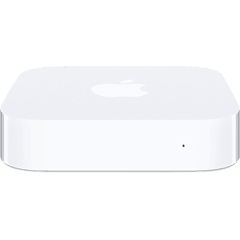 Preview Preview | Release Date 2012.06 Discontinued 2018.04 Color | Speed: 300 Mbps Compatibility: IEEE 802.11a/b/g/n Frequency: Simultaneous dual-band 2.4GHz and 5GHz Power Output: 20.5 dBm maximum (varies by country) Security: WPA, WPA2, and WEP (40-bit or 128-bit) | NAT, DHCP, PPPoE, VPN Passthrough (IPSec, PPTP, and L2TP), DNS Proxy, SNMP, IPv6 (6to4 and manual tunnels) | Ethernet port: 2 USB port: 1 3.5 mm audio jack for analog or optical digital audio: 1 | Height: 23mm Width: 98mm Weight: 240 g | A1392 | On June 11, 2012, Apple introduced an updated AirPort Express with support for simultaneous dual-band 2.4 GHz and 5 GHz 802.11n Wi-Fi. | MC414LL/A |
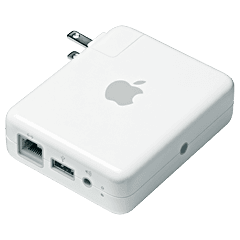 Preview PreviewAirPort Express 802.11n (1st Generation) | Release Date 2008.03 Discontinued 2012.06 Color | Speed: -- Compatibility: IEEE 802.11a/b/g and draft 802.11n Frequency: 2.4GHz or 5GHz Power Output: 20 dBm (nominal) Security: WPA, WPA2, and WEP (40-bit or 128-bit) | NAT, DHCP, PPPoE, VPN Passthrough (IPSec, PPTP, and L2TP), DNS Proxy, SNMP, IPv6 (6to4 and manual tunnels) | Ethernet port: 1 USB port: 1 3.5 mm audio jack for analog or optical digital audio: 1 | Height: 28.5mm Width: 94.01mm Weight: 188 g | A1264 | AirPort Express is a simplified and compact version of the AirPort Extreme Base Station. It supports up to 10 users and includes a feature called AirTunes. It does not replace the AirPort Extreme Base Station. Introduced by Apple on June 7, 2004, it includes an analog/optical mini-audio output jack, a USB port for remote printing, and a single Ethernet port. An updated version supporting the faster 802.11n draft specification and operating in both 2.4 GHz and 5 GHz bands was released on March 17, 2008, with almost identical features. | MB321LL/A |
| Preview AirPort Express | Release Date 2004.06 Discontinued 2008.03 Color | Speed: 54 Mbps Compatibility: IEEE 802.11b/g Frequency: 2.4GHz Power Output: 15 dBm (nominal) Security: WPA, WPA2, and WEP (40-bit or 128-bit) | NAT, DHCP, FTP, PPPoE, VPN Passthrough (IPSec, PPTP, and L2TP), QuickTime streaming, DNS Proxy, SNMP | RJ-45 Ethernet port: 1 USB port: 1 3.5 mm audio jack for analog or optical digital audio: 1 | Height: 28.4mm Width: 94.01mm Weight: 189 g | A1084 / A1088 | In June 2004, Apple released AirPort Express, a scaled-down version of the AirPort Extreme Base Station with AirTunes support. AirTunes allowed iTunes music to be streamed wirelessly to a hi-fi system. This AirPort Express base station was very compact, supporting up to 10 connections, and while it lacked standard Ethernet ports (having only one), it featured an analog/optical digital audio jack. In Japan, it was known as AirMac due to trademark issues. | M9470LL/A |
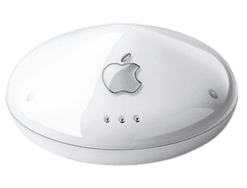 Preview PreviewAirPort Base Station (Dual Ethernet) | Release Date 2001.11 Discontinued 2003.01 Color | Speed: 11 Mbps Compatibility: IEEE 802.11b Frequency: 2.4GHz Power Output: 15 dBm (nominal) Security: WEP (40-bit or 128-bit encryption) | AppleTalk, TCP/IP, NAT, DHCP, UDP, FTP, PPPoE, L2TP, DNS, IPSec/VPN Passthrough, SNMP, Telnet | RJ-45 Ethernet port: 2 RJ-11 port (built-in 56k modem): 1 | Height: 80mm Weight: 565 g | M8440 | In November 2001, Apple released AirPort 2, an upgrade to its predecessor that supported up to 50 connections, 128-bit encryption, and Windows PC support. Additionally, the AirPort 2 base station featured a DSL WAN port for routing. | M8209LL/A |
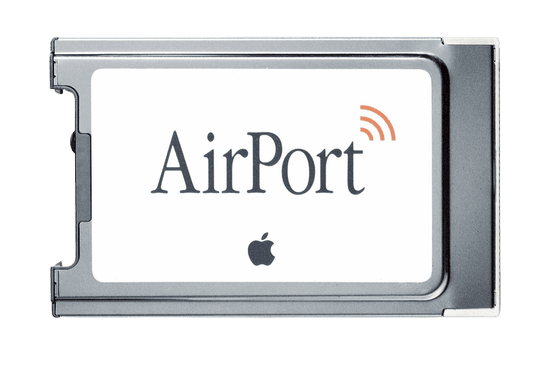 Preview PreviewAirPort Card | Release Date 1999.07 Discontinued 2004.06 Color | Speed: 11 Mbps Compatibility: IEEE 802.11b Frequency: 2.4GHz Power Output: -- Security: -- | -- | -: - | Weight: -- | 630-2899 | The original model, simply called the AirPort Card, was a rebranded Lucent WaveLAN Gold PC card with a modified case that lacked an integrated antenna. It was designed to be user-installable. This modification prevented it from being used directly in a generic PCMCIA slot (making it much cheaper than the official WaveLAN Gold card at the time). Using it in slot-loading iMacs required an AirPort Card Adapter. | M7600LL/A M7600LL/B M7600LL/C (with iMac Adapter) M7600LL/D M7600LL/E |
AirPort Base Station (Graphite) | Release Date 1999.07 Discontinued 2001.11 Color | Speed: 11 Mbps Compatibility: IEEE 802.11b Frequency: 2.4GHz Power Output: 15 dBm (nominal) Security: WEP (40-bit encryption) | AppleTalk, TCP/IP, NAT, DHCP, UDP, FTP, PPPoE, L2TP, DNS, IPSec/VPN Passthrough, SNMP, Telnet | RJ-45 Ethernet port: 1 RJ-11 port (built-in 56k modem): 1 | Height: 80mm Weight: 565 g | M5757 | In 1999, Apple partnered with Lucent Technologies to release AirPort, a new technology launched alongside the original iBook. It was a wireless LAN network supporting speeds up to 11 Mbps (faster than 10Base-T Ethernet). The base station was essentially an Ethernet hub and modem router used to share an internet connection among Macs on an AirPort wireless network. | M7601LL/A M7601LL/B |