Apple I
(1976)Apple Computer Specs History
Horizontal Scroll: Shift + Mouse Wheel
Updated: 2026/03/01
Device Count: 13
Search devices...CtrlK
Diff
Diff Only
Compare
Fullscreen
Zoom
Dark Mode
中文站点
| Model | Basic | Display | Connectivity | Firmware / Power | Other | ||||||
|---|---|---|---|---|---|---|---|---|---|---|---|
Basic Info | Chip / Memory / GPU | Screen Details | Ports | A/V I/O | Firmware | Expansion | Power | Size & Weight | Description | Model Numbers | |
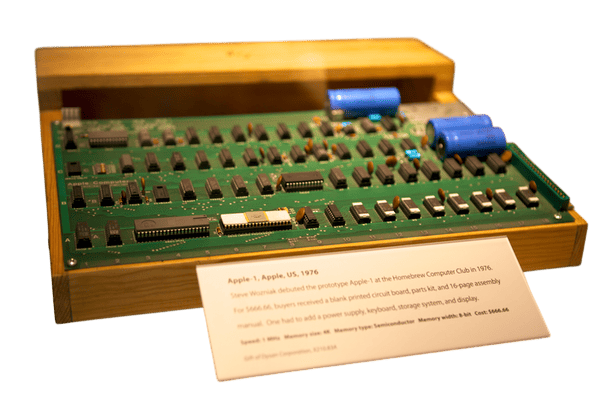 Preview Preview | Release Date 1976.04 OS Support Apple Integer BASIC (with optional cassette interface) Color | 1-Core MOS MOS Technology 6502 Graphics: Built-in graphics RAM: 4 KB built-inMax 65 KB Storage: No built-in hard drive | - | Keyboard: 1 (for ASCII-encoded keyboard DIP) Display port: Composite positive video Audio output: - | Audio output:- | Expansion Slots: 1 x 44-pin expansion connector, 1 x cassette board connector Media Drives: Optional cassette interface | Power Consumption: 58 W (maximum continuous power) | The original Apple Computer, known retroactively as the Apple I or Apple-1, was designed and hand-built by Steve Wozniak. Wozniak's friend Steve Jobs had the idea of selling it as a fully assembled product to finance its creation. The Apple I was Apple's first product, demonstrated in July 1976 at the Homebrew Computer Club and went on sale that same month. It was priced at $666.66 because Wozniak "liked repeating digits" and because it was a one-third markup on the $500 wholesale price. About 200 units were produced and sold, with 25 sold in the first nine or ten months. Unlike other hobbyist computers sold as kits, the Apple I was a fully assembled circuit board containing about 60+ chips. However, to make it a working computer, users still needed to add a case, power transformers, a power switch, an ASCII keyboard, and a composite video display. An optional board providing a cassette interface for storage was available for $72. The Apple I included unique television terminal circuitry. All other single-board computers typically used front-mounted toggle switches and indicators (red LEDs) for output and required separate hardware expansion cards to connect to computer terminals or teletypes, making the Apple I an innovative machine at the time. The price was dropped to $475 in April 1977. Although it was removed from price lists, the Apple II began shipping that same month. The Apple I was officially discontinued from price lists in September 1977. Because Wozniak was the only person who could answer most customer support questions, the company offered Apple I owners discounts and trade-ins to persuade them to return their computers. | - | ||
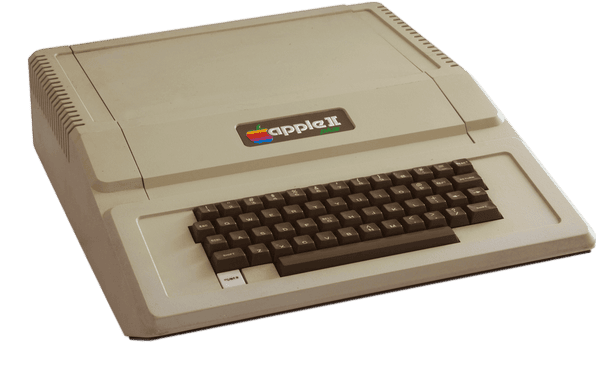 Preview PreviewApple II (1977) | Release Date 1977.04 OS Support Apple DOS 3.1 (after June 1978) Color | 1-Core MOS MOS Technology 6502 Graphics: Built-in graphics RAM: None built-inMax 48 KB Storage: No built-in hard drive | - | Cassette interface: 1 (input), 1 (output) @ 1500 bps Game port: 1 (internal 16-pin GAME I/O) Display port: 1 (RCA composite video output) Audio output: Built-in 8 ohm speaker x 1 | Audio output:Built-in 8 ohm speaker x 1 | Expansion Slots: 8 x 50-pin Apple II peripheral slots Media Drives: Optional Cassette Interface or Disk II floppy drive | Height: 11.3cm Width: 38.7cm Thickness: 45.7cm Weight: 5.2 kg | The first Apple II computers went on sale on June 10, 1977, equipped with a MOS Technology 6502 microprocessor running at 1 MHz with 4 KB of RAM and an audio cassette interface for loading programs and storing data, with the Integer BASIC programming language built into ROM. The video controller displayed 40 columns by 24 rows of monochrome uppercase text (matching ASCII characters 0x20 to 0x5F), suitable for display on a TV monitor via an NTSC composite video output or on a regular TV via a separate RF modulator. Original retail prices were $1,298 for 4 KB RAM and $2,638 for 48 KB RAM. To reflect the computer's character-cell color graphics capabilities, the Apple logo on the case featured rainbow stripes, which was retained until early 1998. Wozniak's open design and the Apple II's multiple expansion slots allowed a variety of third-party devices, including Apple II peripheral cards such as serial controllers, display controllers, memory boards, hard drives, networking components, and real-time clocks. Eventually, Apple II accelerator cards were created to double or quadruple computer speeds. An estimated 40,000 machines were sold during production. | A2S0016 A2S0032 A2S0048 | ||
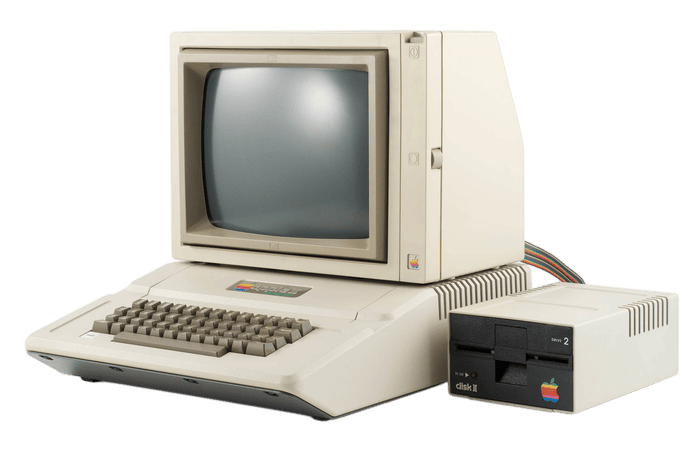 Preview PreviewApple II Plus (1979) | Release Date 1979.06 OS Support Apple DOS 3.2 (initially optional, later included) Color | 1-Core MOS MOS Technology 6502 Graphics: Built-in graphics RAM: 16 KB, 32 KB, or 48 KB built-inMax 64 KB (with Language Card) Storage: No built-in hard drive | - | Cassette interface: 1 (input), 1 (output) @ 1500 bps Game port: 1 (internal 16-pin GAME I/O) Display port: 1 (RCA composite video output) Audio output: Built-in 8 ohm speaker x 1 | Audio output:Built-in 8 ohm speaker x 1 | Expansion Slots: 8 x 50-pin Apple II peripheral slots Media Drives: Optional Cassette Interface or Disk II floppy drive | Height: 11.3cm Width: 38.7cm Thickness: 45.7cm Weight: 5.2 kg | The Apple II Plus was introduced in June 1979, featuring the Applesoft BASIC programming language in ROM. This was a Microsoft-licensed BASIC dialect, previously available as an upgrade, that supported floating-point arithmetic and became the standard BASIC dialect for the Apple II series. It shipped with 16 KB, 32 KB, or 48 KB of main RAM, expandable to 64 KB with a Language Card that could be installed in slot 0. The 6502 microprocessor supported a maximum of 64 KB of address space, and a 48 KB RAM machine reached this limit due to an additional 12 KB of read-only memory and 4 KB of I/O addressing. For this reason, the Language Card bank-switched over the machine's built-in ROM, allowing code loaded from disk into extra memory to run as if it were actually in ROM. Users could thus load disks and switch between Integer BASIC and Applesoft dialects. Like the Apple II, the Apple II Plus had no lowercase capability; all letters on the keyboard were uppercase, with no Caps Lock key, and no lowercase letters in the text-mode font. | A2S1016 A2S1032 A2S1048 | ||
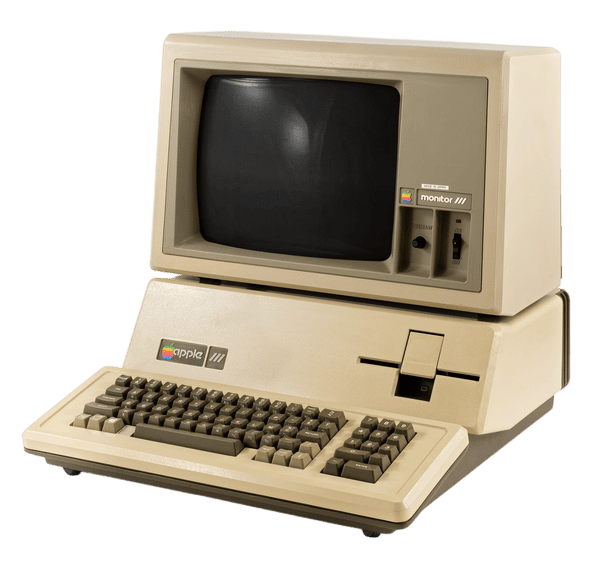 Preview PreviewApple III (1980) | Release Date 1980.11 OS Support Apple Sophisticated Operating System 1.0 Color | 1-Core MOS MOS Technology 6502A Graphics: Built-in graphics RAM: 128 KB or 256 KB built-inMax 512 KB Storage: Optional 5 MB Apple ProFile hard drive | - | Serial port: 1 (DB-25 RS-232C compatible), 2 (DB-9) Floppy port: 1(26-pin) Display port: 1 (RCA composite video output), 1 (DB-15) Audio output: 1 x 3.5 mm analog output jack, 1 x built-in speaker | Audio output:1 x 3.5 mm analog output jack, 1 x built-in speaker | Expansion Slots: 4 x 50-pin Apple II peripheral slots Media Drives: Built-in 140 KB 5.25-inch floppy drive | Power Consumption: 100 W (maximum continuous power) | Height: 12.2cm Width: 45cm Thickness: 46.2cm Weight: 11.8 kg | The Apple III (often rendered as Apple ///) was a business-oriented personal computer intended to be the successor to the Apple II series, but was ultimately considered a market failure. Announced on May 19, 1980, and released later that year, severe stability issues required a redesign and recall of the first 14,000 machines. The Apple III was formally reintroduced on November 9, 1981. It was regarded as the business successor to the Apple II. While the Apple II had inspired important business products like VisiCalc, Multiplan, and Apple Writer, its hardware architecture, operating system, and developer environment limited its applicability for business. The Apple III addressed these weaknesses. According to Steve Wozniak, VisiCalc and Disk II made the Apple II popular, with 90% of sales going to businesses rather than hobbyists, leaving those original designs with flaws. | A3P0001 A3P0002 A3P0003 A3S0128 A3S0256 | |
| Preview Apple III Plus (1983) | Release Date 1983.12 OS Support Apple Sophisticated Operating System 1.3 Color | 1-Core MOS MOS Technology 6502B Graphics: Built-in graphics RAM: 256 KB built-inMax 512 KB Storage: Optional 5 MB Apple ProFile hard drive | - | Serial port: 1 (DB-25 RS-232C compatible), 2 (DB-9) Floppy port: 1(DB-25) Display port: 1 (RCA composite video output), 1 (DB-15) Audio output: 1 x 3.5 mm analog output jack, 1 x built-in speaker | Audio output:1 x 3.5 mm analog output jack, 1 x built-in speaker | Expansion Slots: 4 x 50-pin Apple II peripheral slots Media Drives: Built-in 140 KB 5.25-inch floppy drive | Power Consumption: 100 W (maximum continuous power) | Height: 12.2cm Width: 45cm Thickness: 46.2cm Weight: 11.8 kg | The Apple III Plus was introduced in December 1983 at a price of $2,995, featuring video interface improvements, standardized rear port connectors, 256 KB of RAM as standard, and a redesigned keyboard. Owners of earlier Apple III models could obtain an "Apple III Plus Upgrade Kit," which included a keyboard, case, keyboard encoder ROM, and logo replacements. A new logic board design featured lower power requirements, wider traces, and better sockets for chips. | A3S1256 | |
Apple IIe (1983) | Release Date 1983.01 OS Support Apple DOS 3.3 and ProDOS 8 Color | 1-Core MOS MOS Technology 6502A Graphics: Built-in graphics RAM: 64 KB built-inMax 1 MB (actual) / 128 KB (Apple official) Storage: No built-in hard drive | - | Cassette interface: 1 (input), 1 (output) @ 1500 bps Game port: 1 (internal 16-pin GAME I/O), 1 (external DE-9) Display port: 1 (RCA composite video output) Audio output: Built-in speaker x 1 | Audio output:Built-in speaker x 1 | Firmware Support: Apple II ROM | Expansion Slots: 7 x 50-pin Apple II peripheral slots, 1 x 60-pin auxiliary slot Media Drives: Optional Cassette Interface, Disk II, or DuoDisk floppy drive | Power Consumption: 80 W (maximum continuous power) | Height: 11.3cm Width: 38.7cm Thickness: 45.7cm Weight: 5.2 kg | The successor to the Apple II Plus was 1983's Apple IIe, a cost-reduced yet more powerful machine that used fewer chips to reduce component count and add new features like lowercase letter display on screens and standard 64 KB RAM. The IIe's RAM was configured as if it were a 48 KB Apple II Plus with a Language Card; the machine had no slot 0, but rather an Auxiliary Slot used primarily for 80-column cards in location slot 3 of the II Plus. The Apple IIe was Apple's most popular Apple II and the "workhorse" of the line, as well as one of the longest-lived Apple computers ever made—manufactured and sold for nearly 11 years with minor changes. | - |
Apple IIe Enhanced (1985) | Release Date 1985.03 OS Support Apple DOS 3.3 and ProDOS 8 Color | 1-Core MOS MOS Technology 65C02 Graphics: Built-in graphics RAM: 128 KB built-inMax 1 MB (actual) / 128 KB (Apple official) Storage: No built-in hard drive | - | Cassette interface: 1 (input), 1 (output) @ 1500 bps Game port: 1 (internal 16-pin GAME I/O), 1 (external DE-9) Display port: 1 (RCA composite video output) Audio output: Built-in speaker x 1 | Audio output:Built-in speaker x 1 | Firmware Support: Apple II ROM | Expansion Slots: 7 x 50-pin Apple II peripheral slots, 1 x 60-pin auxiliary slot Media Drives: Optional Cassette Interface, Disk II, or DuoDisk floppy drive | Power Consumption: 80 W (maximum continuous power) | Height: 11.3cm Width: 38.7cm Thickness: 45.7cm Weight: 5.2 kg | The Apple IIe Enhanced was an upgraded version of the Apple IIe utilizing four new replacement chips giving it some of the capabilities of the later-model Apple IIc, including the upgraded 65C02 processor, 128 KB memory, and DHGR graphics mode. An Enhanced IIe with 128 KB of RAM could be considered the minimum requirement for running most Apple II software released from about 1988 onwards. | - |
Apple Lisa (1983) | Release Date 1983.01 OS Support Lisa Office System 1.0 Color | 1-Core Motorola Motorola 68000 Graphics: Built-in graphics RAM: None built-inMax 2 MB Storage: External 5 or 10 MB Apple ProFile hard drive | 12-inch Monochrome display Built-in CRT Resolution: 720 x 364 Color: Monochrome | Modem: - Serial port: 2(RS-232C),1(DE-9) Parallel port: 1(D-25) Display port: 1 (RCA composite video output) Audio output: Continuously Variable Slope Demodulator (CVSD) | Audio output:Continuously Variable Slope Demodulator (CVSD) | Expansion Slots: 3 x Apple Lisa expansion slots Media Drives: 2 x built-in 871 KB Apple FileWare 5.25-inch floppy drives | Power Consumption: 270 W (maximum continuous power) | Height: 35.1cm Width: 47.6cm Thickness: 38.6cm Weight: 21.8 kg | The Lisa was the first commercial personal computer to offer a graphical user interface for individual users. The Lisa was in many ways more advanced than the Macintosh of the time, featuring built-in memory protection, cooperative multitasking, a hard drive-based general-purpose operating system, a built-in screensaver, an advanced calculator with paper tape and RPN (supporting up to 2 MB RAM), expansion slots, a numeric keypad, data corruption protection schemes (such as spare block management, non-physical filenames allowing multiple documents of the same name), and a higher resolution display. Many of these features were not implemented on the Macintosh platform until years later. For example, memory protection did not return until the release of Mac OS X in 2001. | 2 | |
Apple Lisa 2 (1984) | Release Date 1984.01 OS Support Lisa Office System 3.1 Color | 1-Core Motorola Motorola 68000 Graphics: Built-in graphics RAM: None built-inMax 2 MB Storage: Built-in 10 MB HD, optional external 5 or 10 MB Apple ProFile HD | 12-inch Monochrome display Built-in CRT Resolution: 720 x 364 Color: Monochrome | Modem: - Serial port: 2(RS-232C),1(DE-9) Parallel port: 1 (D-25, for Lisa 2/10 internal hard drive) Display port: 1 (RCA composite video output) Audio output: Built-in speaker x 1 | Audio output:Built-in speaker x 1 | Expansion Slots: 3 x Apple Lisa expansion slots Media Drives: Built-in 400 KB 3.5-inch floppy drive | Power Consumption: 150 W (maximum continuous power) | Height: 35.1cm Width: 47.6cm Thickness: 38.6cm Weight: 25 kg | The Lisa 2 was released in January 1984, priced between $3,495 and $5,495. It was significantly cheaper than the original model and dropped the Twiggy floppy drives in favor of a single 400 KB Sony micro-floppy drive, available with a minimum of 512 KB RAM. The Lisa 2/5 included an external 5 MB or 10 MB hard drive. In 1984, alongside the official launch of the Macintosh, Apple offered all Lisa 1 owners a free upgrade to Lisa 2/5, swapping the pair of Twiggy drives for a single 3.5-inch drive and updating the boot and I/O ROMs. Additionally, a new front panel design on the Lisa 2 accommodates the reconfigured floppy drive. This change made the Lisa 2 the model onto which the new Apple rainbow logo and first Snow White design language characteristics were introduced. The Lisa 2/10 featured a 10 MB internal hard drive (but no external parallel port) and standard 1 MB RAM configurations. | 2 | |
Apple IIc (1984) | Release Date 1984.04 OS Support ProDOS 8 Color | 1-Core MOS MOS Technology 65C02 Graphics: Built-in graphics RAM: 128 KB built-inMax 1.12 MB (later versions) Storage: No built-in hard drive | - | Serial port: 2(DIN-5) Floppy port: 1(DB-19) Game port: 1(DE-9) Display port: 1 (RCA composite video output), 1 (DB-15) Audio output: 1 x 3.5 mm analog output jack, 1 x built-in speaker | Audio output:1 x 3.5 mm analog output jack, 1 x built-in speaker | Firmware Support: Apple II ROM | Expansion Slots: None Media Drives: Built-in 140 KB 5.25-inch floppy drive | Power Consumption: 25 W (external power supply) 18 W (internal converter) | Height: 6.4cm Width: 30.5cm Thickness: 29.2cm Weight: 3.4 kg | Apple released the Apple IIc in April 1984, promoting it as a portable Apple II because it could be easily carried, although not built-in with a monitor and battery like modern laptops, the IIc even featured a folding handle that supported typing. It was the first of three Apple II models in the Snow White design language and the only one using the off-white creamy color. The Apple IIc featured a built-in 5.25-inch floppy drive and 128 KB of RAM, built-in disk controller (NTSC or PAL) composite video, serial interfaces (for modems and printers), and a port for a joystick or mouse. Unlike previous Apple II models, the IIc had no internal expansion slots, a means to achieve its compact size. Third parties eventually found ways to stuff up to 1 MB of extra memory and a real-time clock into the machine, and later motherboard revisions offered an expansion slot that accepted an Apple memory card carrying up to 1 MB of RAM. The disk port originally meant for a second 5.25-inch floppy drive could eventually connect 3.5-inch disk drives and (through third parties) even hard drives. | A2S4100 |
Apple IIGS (1986) | Release Date 1986.09 OS Support ProDOS 16 or GS/OS Color | 1-Core WDC WDC 65C816 Graphics: Custom Video Graphics Controller (VGC) RAM: 256 KB or 1.125 MB built-in (depending on version)Max 8.125 MB Storage: No built-in hard drive | - | ADB: 1 Serial port: 2(mini DIN-8) Floppy port: 1(DB-19) Game port: 1 (internal 16-pin GAME I/O), 1 (external DE-9) Display port: 1 (RCA composite video output), 1 (DB-15) Audio output: 1 x 3.5 mm analog output jack, 1 x built-in speaker | Audio output:1 x 3.5 mm analog output jack, 1 x built-in speaker | Firmware Support: Apple II ROM | Expansion Slots: 7 x 50-pin Apple II peripheral slots Media Drives: Optional Apple 3.5, Apple 5.25, or UniDisk floppy drive | Backup Battery: 3.6 V lithium battery Power Consumption: 60 W (maximum continuous power) | Height: 11.7cm Width: 28.4cm Thickness: 34.8cm Weight: 4 kg | The Apple IIGS differed significantly from existing Apple II lines, featuring a true 16-bit 65C816 microprocessor running at 2.8 MHz with 24-bit addressing, allowing expansion up to 8 MB of RAM. Early machines bank-switched entirely new graphics modes supporting higher resolutions and a 4096-color palette; however, it was limited to only 4 colors per line at 640×200 resolution (or 16 colors at 320×200). The Apple IIGS evolved from previous Apple II models into a next-generation computing platform while maintaining near-total backward compatibility. The secret to the Apple IIGS's compatibility was a single chip named Mega II, containing functional equivalents of earlier Apple II computers (without processors). This, paired with the 65C816 processor's flawless 6502 emulation mode, provided complete support for older software. The computer also contained a 32-channel Ensoniq 5503 "wavetable" sampling music synthesizer chip with 64 KB of dedicated RAM, built-in peripheral ports (switchable like a buzzer), a mouse device, built-in AppleTalk networking, and a ROM Toolbox supporting a graphical user interface derived from the Macintosh Toolbox. It could run existing 8-bit Apple II software but also supported 16-bit software under a new OS (initially ProDOS 16, later GS/OS), which eventually included a Finder to manage disks and open/close documents ala Macintosh. The 16-bit OS automatically switched to text display and downgraded to 8-bit mode to run legacy software while providing a consistent, Macintosh-like graphical interface for native 16-bit applications. Eventually, the IIGS gained abilities to read and write Macintosh disks and even multitask with third-party software. The first 50,000 Apple IIGS computers featured Steve Wozniak's "Woz" signature silkscreened on the front, known as the "Woz Limited Edition." | A0012LL/A |
Apple IIe Platinum (1987) | Release Date 1987.01 OS Support Apple DOS 3.3 and ProDOS 8 Color | 1-Core MOS MOS Technology 65C02 Graphics: Built-in graphics RAM: 128 KB built-inMax 1 MB Storage: No built-in hard drive | - | Cassette interface: 1 (input), 1 (output) @ 1500 bps Game port: 1 (internal 16-pin GAME I/O), 1 (external DE-9) Display port: 1 (RCA composite video output) Audio output: Built-in speaker x 1 | Audio output:Built-in speaker x 1 | Firmware Support: Apple II ROM | Expansion Slots: 7 x 50-pin Apple II peripheral slots, 1 x 60-pin auxiliary slot Media Drives: Optional Cassette Interface, Disk II, or DuoDisk floppy drive | Power Consumption: 80 W (maximum continuous power) | Height: 11.3cm Width: 38.7cm Thickness: 45.7cm Weight: 5.2 kg | The successor to the Apple II Plus was 1983's Apple IIe, a cost-reduced yet more powerful machine that used fewer chips to reduce component count and add new features like lowercase letter display on screens and standard 64 KB RAM. The IIe's RAM was configured as if it were a 48 KB Apple II Plus with a Language Card; the machine had no slot 0, but rather an Auxiliary Slot used primarily for 80-column cards in location slot 3 of the II Plus. The Apple IIe was Apple's most popular Apple II and the "workhorse" of the line, as well as one of the longest-lived Apple computers ever made—manufactured and sold for nearly 11 years with minor changes. During this time, two significant variations were introduced: Enhanced (four new replacement chips giving it some features of the later Apple IIc, including an upgraded 65C02 processor) and the Apple IIe Platinum (enclosure color modernized to Platinum to match other era Apple products, plus an integrated numeric keypad). An Enhanced IIe with 128 KB RAM was considered the minimum requirement for running most Apple II software from around 1988 onwards. The /e models had 128 KB memory on the standard IIe, DHGR graphics mode, and the 65C02 CPU. | A2S2128 |
Apple IIc Plus (1988) | Release Date 1988.09 OS Support ProDOS 8 Color | 1-Core MOS MOS Technology 65C02 Graphics: Built-in graphics RAM: 128 KB built-inMax 1.15 MB (via memory expansion card) Storage: No built-in hard drive | - | Modem port: 1 (internal modem connector) Serial port: 2(mini DIN-8) Floppy port: 1(DB-19) Game port: 1(DE-9) Display port: 1 (RCA composite video output), 1 (DB-15 video output) Audio output: Built-in speaker x 1 | Audio output:Built-in speaker x 1 | Firmware Support: Apple II ROM | Expansion Slots: None Media Drives: Built-in 800 KB 3.5-inch floppy drive | Power Consumption: 20 W (maximum continuous power) | Height: 6.4cm Width: 30.5cm Thickness: 29.2cm Weight: 3.4 kg | The Apple IIc Plus was the last model in the Apple II series, introduced in 1988. It featured the same size and form factor as the previous IIc but replaced the 5.25-inch floppy drive with a 3.5-inch drive, moved the power supply inside the case, and featured a fast 4 MHz 65C02 processor, running 8-bit Apple II software faster than the IIGS. Like the later original Apple IIc, the IIc Plus included a memory expansion slot to accept daughtercards carrying up to 1 MB of RAM. The IIc Plus also adopted a new keyboard layout matching the IIe Platinum and IIGS. | A2S4500 |