Twentieth Anniversary Macintosh Keyboard
Early Mouse & Keyboard Specs History
Horizontal Scroll: Shift + Mouse Wheel
Updated: 2026/08/18
Device Count: 17
Search devices...CtrlK
Diff
Diff Only
Compare
Fullscreen
Zoom
Dark Mode
中文站点
| Model | Basic | Connectivity | Other | ||||||
|---|---|---|---|---|---|---|---|---|---|
Basic Info | System / Model Requirements | Connection | Ports | Size & Weight | Dimensions Note | Model Numbers | Order Number | Description | |
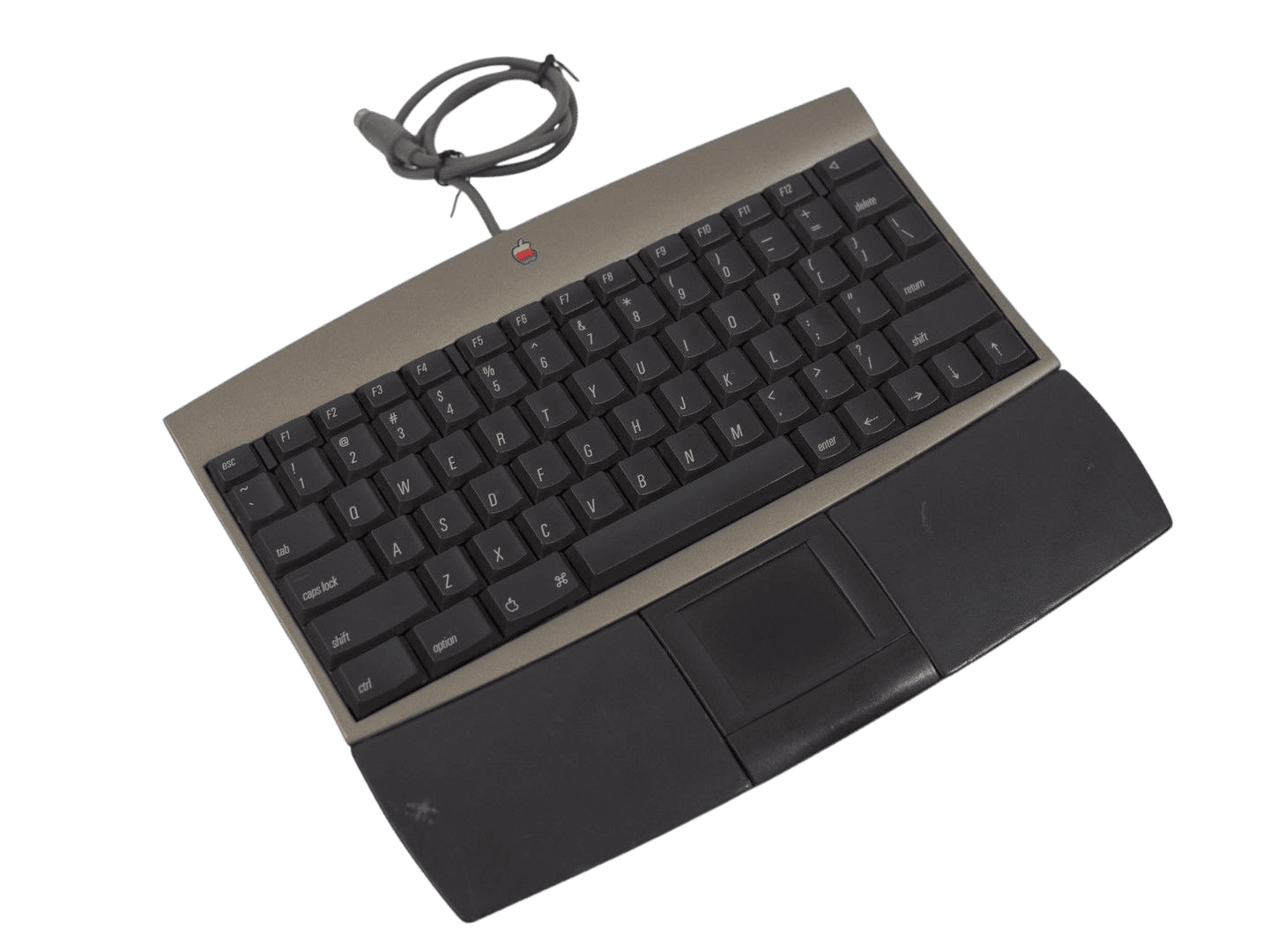 | Release Date 1997.06 Discontinued 1998.03 Color | Twentieth Anniversary Macintosh | ADB | 2 × ADB (1 for Trackpad) | - | - | M3459 | Included with Twentieth Anniversary Macintosh | The Twentieth Anniversary Macintosh came with a unique 76 key ADB keyboard which featured leather palm-rests and a trackpad instead of a mouse. The trackpad could be detached from the keyboard if desired, with a small leather insert found underneath the keyboard ready to fill the gap. When not required, the keyboard could slide under the TAM's head unit, leaving the trackpad exposed for continued access. The TAM also came with a remote control (standard with the Apple TV/FM Tuner card), but also featured buttons on the front panel that could control sound levels, CD playback, brightness, contrast, and TV mode. |
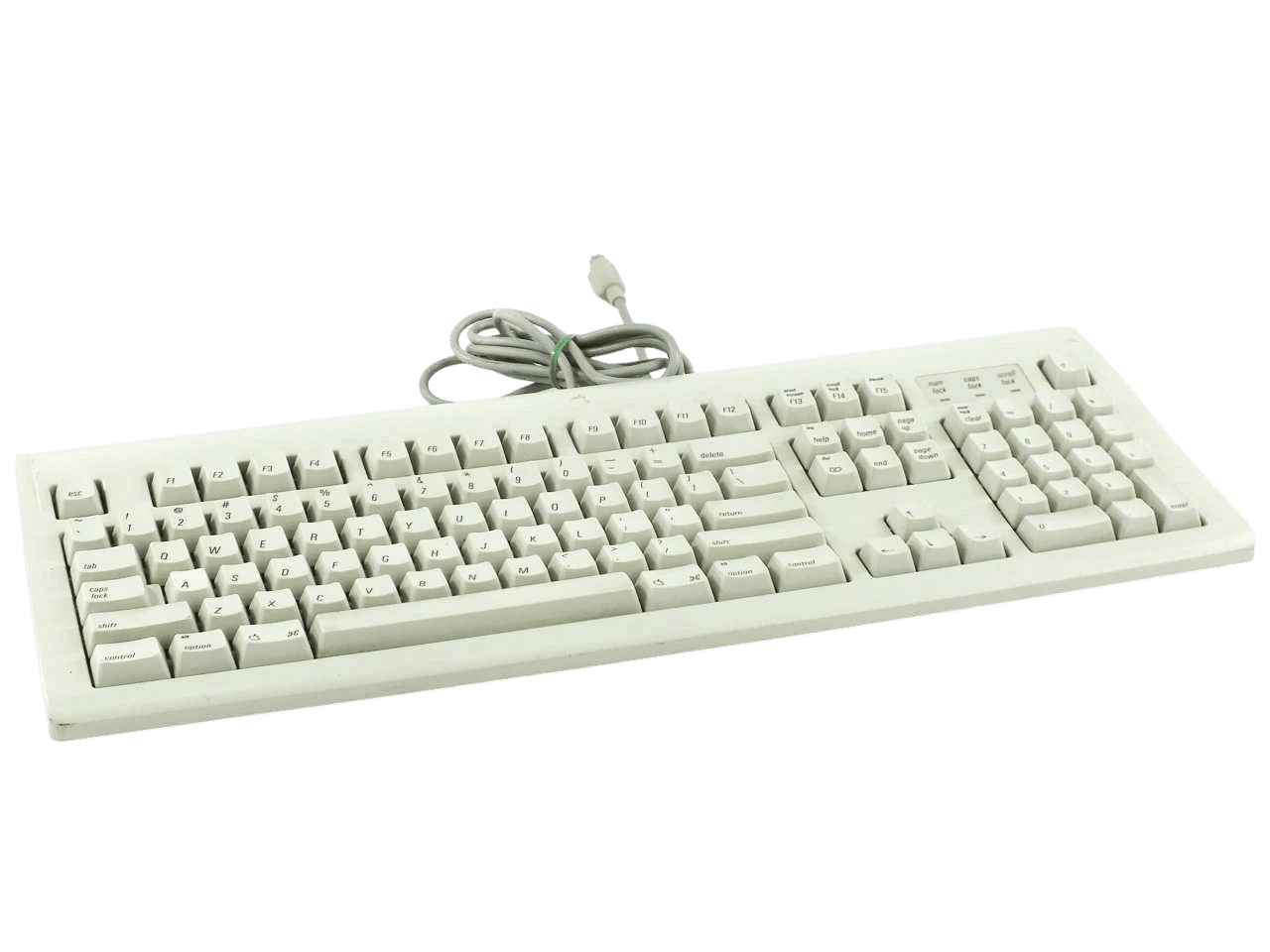 AppleDesign Keyboard | Release Date 1994.03 Discontinued 1999.01 Color | Apple Macintosh computer with ADB port | ADB | 2 × ADB | Height: 1.9 (front) ~ 4.0 (rear)cm Width: 47.5cm Thickness: 19.6cm Weight: 1.2 kg | - | M2980 | M2891LL/A | This was the first major redesign of the Apple keyboard, featuring more fluid, curving lines to match the look of the new Apple product style. It was an unpopular replacement for the Apple Extended Keyboard II in 1994. Significantly lighter than its predecessors, it had a much softer and quieter key interface that was unpopular with many typists. This keyboard was also produced in black using the same model number (like the Apple Keyboard II before it), specifically for inclusion with the black Performa 5420 released primarily in Europe. |
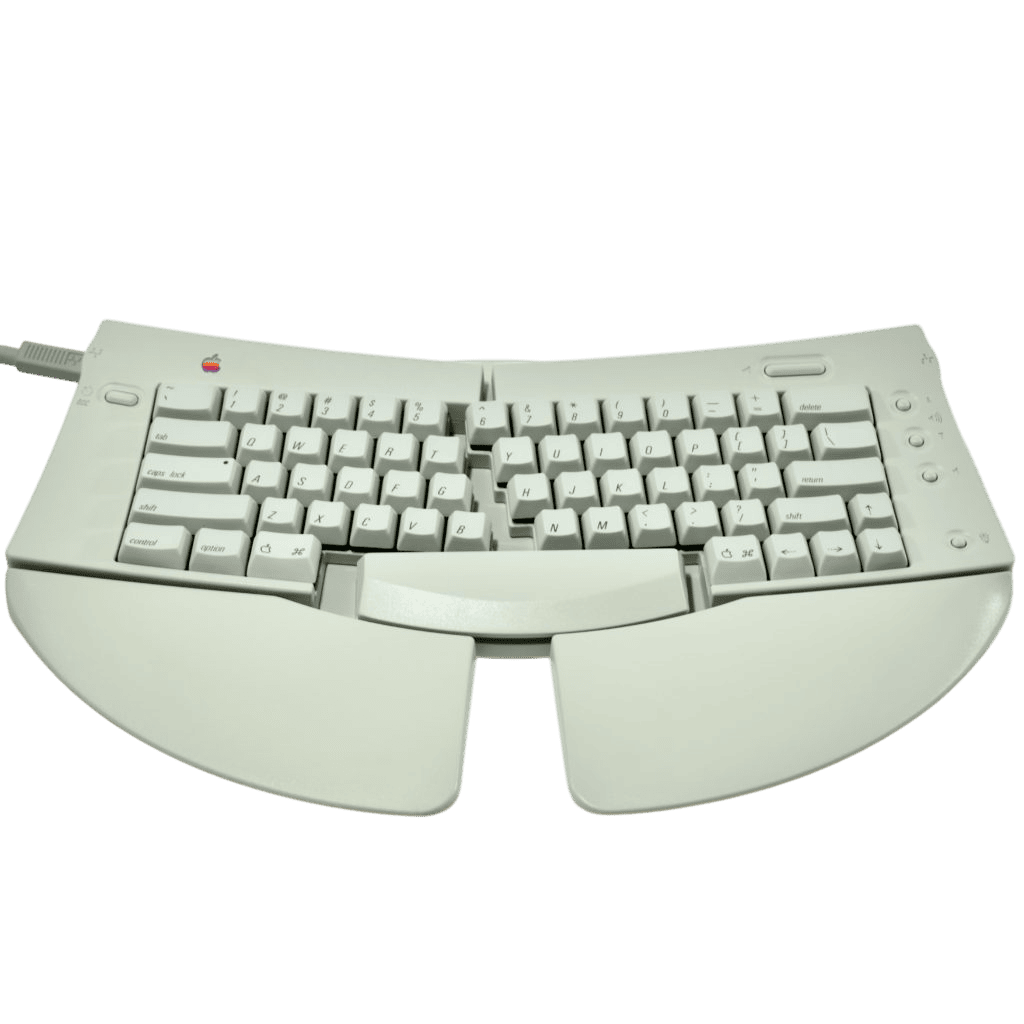 Apple Adjustable Keyboard | Release Date 1993.01 Color | Macintosh with ADB port System 6.0.7 or later | ADB | - | Height: 3.5cm Width: 38.4cm Thickness: 15.9cm Weight: 1.1 kg | Separate keypad array: 3.5 × 24.8 × 14.4 cm, 0.1 kg | M1242 | M1242LL/A | The Apple Adjustable Keyboard was introduced in 1993 at a retail price of $219 U.S. The keyboard attached to the computer via the Apple Desktop Bus (ADB). It aimed to solve repetitive stress injuries resulting in carpal tunnel syndrome, after several computer keyboard manufacturers were sued for poor design. The Apple Adjustable Keyboard came with contoured plastic wrist rests, and a separate keypad with function keys and arrow keys. This was the third and last time Apple offered a separate numeric keypad. Unlike its predecessors, it was not sold separately. The keyboard also included volume buttons and a record button on the right side of the keyboard. It was hinged at the top, allowing the user to adjust the angle between the right and left sides of the keyboard. The split came between the key pairs: 5/6, T/Y, G/H, and B/N. The space bar floated midway between the two parts. |
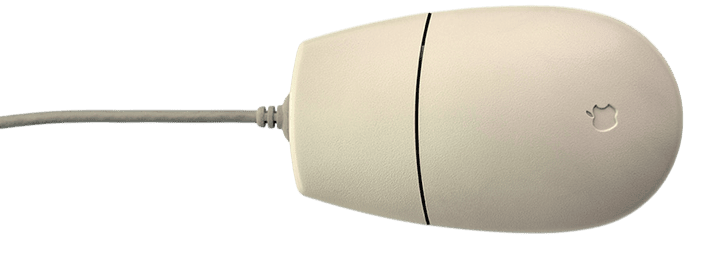 Apple Desktop Bus Mouse II | Release Date 1993.01 Discontinued 1999.01 Color | Macintosh or Apple II computer with ADB port | ADB | - | Height: 3.3cm Width: 6.1cm Thickness: 10.7cm Weight: 132 g | - | M2706 / M2707 | M2706LL/A | In only its third major redesign in ten years, the Apple mouse shed its blocky exterior for rounded curves. The so-called tear-drop mouse, was essentially the same as its predecessor but with a new case subsequently held as the ideal shape of mice. Indeed, the basic design has persevered into current models, as well as being widely adopted by other mouse manufacturers. It was included with all Macintosh desktop computers from 1993 until 1998 in platinum color under the model M2706. It was also the first mouse produced by Apple in black to match the Macintosh TV as well as the Performa 5420 sold in black; also under the model M2706. A dark gray version was released in 1993 as a color coded accessory for the PowerBook 100 series under the model M2707. |
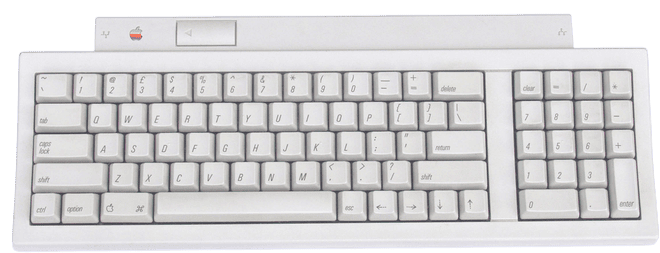 Apple Keyboard II | Release Date 1990.10 Discontinued 1992 Color | Apple Macintosh computer with ADB port | ADB | - | Height: 3.3cm Width: 40.6cm Thickness: 15cm Weight: 0.89 kg | - | M0487 | M0487LL/A | Introduced and sold with the Macintosh LC in 1990, this keyboard was almost identical to the original ADB Keyboard, but included flip down feet to change the typing angle and a design change that gave the frame and keys a more substantial appearance. In 1993, The Macintosh TV was the first Mac introduced in all black. It came with an identical black Keyboard II (using the same model number). |
Apple Extended Keyboard II | Release Date 1990.10 Discontinued 1994.03 Color | Apple Macintosh computer with ADB port | ADB | - | Height: 1.9 (front) ~ 4.0 (rear)cm Width: 47.5cm Thickness: 19.6cm Weight: 1.2 kg | - | M3501 | M0312 | A minor update to the Apple Extended Keyboard to coincide with the release of the Macintosh IIsi in 1990, it added an adjustable height feature. |
Apple Extended Keyboard | Release Date 1987.03 Discontinued 1990.10 Color | Macintosh with ADB port | ADB | - | - | - | M0115 | - | This keyboard, the first to be sold optionally, was essentially a redesigned version of the Apple Keyboard, with it was an enhanced extended keyboard with FKeys and other PC-style keys. It included template guides above the top row of function keys to accommodate shortcut key references which accommodate many software packages. It was the heaviest of all the Macintosh keyboards and set the standard for many typists. |
Apple Standard Keyboard | Release Date 1987.03 Discontinued 1990 Color | Apple or Macintosh with ADB port | ADB | - | Height: 4.4cm Width: 41.9cm Thickness: 14.2cm Weight: 1 kg | - | M0116 / M0118 | - | Also known as the Apple Standard Keyboard, it was the first to officially use this name. Apple would later reuse it for a series of successive keyboards. The Apple Keyboard was a more solid version of the Apple Desktop Bus Keyboard. Included with the Macintosh II in 1987, the heftier design solidified visually the power performance embodied by the Mac II. Aside from weight the main difference was the significantly thicker frame width. |
Apple Desktop Bus Mouse | Release Date 1986.09 Discontinued 1993.01 Color | Apple IIGS or Macintosh with ADB port | ADB | - | - | - | G5431 / A9M0331 | - | In September of 1986 Apple continued a year of major change by converting its mice and keyboards to the Apple Desktop Bus (ADB). Newly redesigned, the updated mouse retained the blocky design of its predecessor, but was more wedge shaped and had a much lower-profile. The first official Snow White design language mouse (the Apple Mouse IIc was technically the first), it was a uniform Platinum gray color, including the single button, with only the cables and connectors retaining the contrasting darker gray "Smoke" color. It was introduced on the Apple IIGS computer and later became the standard included mouse with all Macintosh desktop computers for the next 6 years. |
Apple Desktop Bus Keyboard | Release Date 1986.01 Discontinued 1990 Color | Apple or Macintosh with ADB port | ADB | - | Height: 4.4cm Width: 41.9cm Thickness: 14.2cm Weight: 1 kg | - | A9M0330 | - | This was the first Apple keyboard to use the new input connection method the Apple Desktop Bus (ADB), first released and sold with the Apple IIGS. Designed to be used with both the Macintosh and Apple product lines it was the first to combine both the Macintosh Command Key and Apple "open" Apple key. Entirely Platinum gray in color (the Macintosh Plus has darker gray keys called "Smoke"), it was also the first to use Snow White design language that was similar to the Apple IIc. However, it duplicated the extended design established by the Plus. It was also the first to include an external power/reset button and an extra ADB port. |
Macintosh Plus Keyboard | Release Date 1986.01 Discontinued 1990.10 Color | Macintosh with RJ11 connector | RJ-11 | - | - | - | M0110A | - | Introduced and included with the Macintosh Plus in 1986, it was an extended keyboard that had a built-in numeric keypad. In 1987 it was updated to Apple's new Platinum gray color. It continued to use the telephone-cord style connector to the CPU and was interchangeable with the M0110. Though Apple switched all other keyboards to Apple Desktop Bus connectors by this time, this keyboard was manufactured unchanged until the Plus was discontinued in 1990. |
Macintosh Numeric Keypad | Release Date 1984.09 Discontinued 1986.01 Color | Macintosh with RJ11 connector | RJ-11 | - | Height: 5.7cm Width: 14.6cm Thickness: 10.8cm Weight: 0.325 kg | - | M0120 / M0120P | - | Like the Apple IIe before it, the Macintosh provided an optional external keypad which also included arrow keys that daisy chained to the computer via the telephone-cord connectors. Though introduced with the Macintosh in January 1984, Apple did not ship it until September 1984 at a retail price of $99 U.S. The M0120P version of the numeric keypad, compared to M0120, uses symbols on the Clear and Enter keys, instead of text. |
Apple Mouse IIc | Release Date 1984.04 Discontinued 1988 Color | Apple II series with Apple II Mouse Card, or Apple IIc Macintosh with DE9 port | DE-9 | - | - | - | M0100 / A2M4015 / A2M4035 | - | Four months after the Macintosh debut, the Apple IIc was introduced with the addition of an optional mouse to manipulate standard 80 column text. The mouse was similar to the Macintosh mouse, though it was in a creamy-beige color that co-ordinated with the IIc's bright off-white case and had a slightly modified design which was sleeker than the Macintosh's blockier shape. It also was uniformly the same color, eliminating the Mac and Lisa's contrasting taupe accents on the mouse button and cable. Unlike the Macintosh, the IIc Mouse shared a dual purpose port with gaming devices like joysticks. In order for the IIc to know what was plugged into it, its mouse had to send the appropriate signal. Despite these differences, it carried exactly the same model number as the Macintosh version. Since the original Apple Mouse IIc was compatible across all platforms, Apple renamed the mouse in 1985 and offered it as an optional purchase for all computers and separate from the Apple II interface card. It featured an updated mechanism and the new uniform rounded cable connector. |
Apple Mouse II | Release Date 1984.04 Discontinued 1986 Color | Apple II series with Apple II Mouse Card (except Apple IIc) Macintosh with DE9 port | DE-9 | - | - | - | M0100 / A2M2050 / A2M2070 | - | By mid-1984, Apple's commitment to bringing the mouse to its entire product line resulted in the release of the Apple II Mouse Card. Since this was a dedicated mouse port, Apple simply re-packaged the Macintosh mouse, but with the same creamy-beige cable and connector used on the IIc mouse and bundled it along with special software called MousePaint for use with the Apple II, II Plus, and IIe computers. Like the original IIc mouse, it used the same model number as the Macintosh. Unlike the Mouse IIc, however, it can be interchanged with the Macintosh version, but cannot be used on the IIc. Due to the popularity of the Macintosh and shortage of mice, Apple later repackaged the original Apple Mouse IIc in this bundle as well since it was cross-platform compatible. The Apple Mouse II and its successors were never included as standard equipment on any computer. By 1986 Apple had updated its product lines with new cable connectors. With the Apple IIe already three years old, the AppleMouse II was re-badged for the IIe alone and essentially used a repackaged Macintosh Mouse with no modifications. Later it would also use the Platinum Macintosh version. |
Macintosh Keyboard | Release Date 1984.01 Discontinued 1986.01 Color | Macintosh with RJ11 connector | RJ-11 | - | - | - | M0110 | - | Introduced and included with the original Macintosh in 1984, it debuted without arrow keys to control the cursor nor an integrated numeric keypad. It used a unique telephone-cord style connector to the CPU. It also introduced a unique Command Key similar to the "open" Apple Key on the Lisa. |
Macintosh Mouse | Release Date 1984.01 Discontinued 1987 Color | Macintosh with DE9 port | DE-9 | - | - | - | M0100 | - | The Macintosh has the distinction of launching the mouse as the indispensable computing device we know it as today. However, its mouse was little changed from the original Lisa version and is completely interchangeable. The case was a slightly darker brown than Lisa's beige coloring and it had less formal lines, with a thick chamfer around its edges to match the Macintosh case. Mechanically the Lisa's steel ball was replaced by a rubber one, but otherwise connected with the same DE-9 connectors, though updated with a square-shape and standard thumb screws. |
Apple Graphics Tablet | Release Date 1979.10 Color | Apple II Plus with 48 KB of memory A suitable video display device Apple Disk II drive with controller Graphics Tablet Interface Card | Molex connectors (non-RFI) / DB-9 via internal cables (RFI) | 2 × Molex on Interface Card (non-RFI) 2 × DB-9 on Interface Card internal cables (RFI) | Height: 39.5cm Width: 39.5cm Thickness: 2.5cm | Pen: 15.2 cm with 1.8 m cable | A2M0029 (non-RFI) / A2M2007 (RFI) | - | The Apple Graphics Tablet was introduced in 1979 to enable users to create graphics and pictures on the Apple II series using a wired pen. The software allowed the drawing of accurate line segments through specifying their endpoints. The images could be rotated, translated, and magnified. The software was also able to perform calculations, for example you could convert screen units into square feet through a scaling feature. In spring 1983, the original version was replaced with an updated model to address issues with electromagnetic interference. The non-RFI and RFI models were functionally identical aside from the modifications to address the interference. The Graphics Tablet connects to the Graphics Tablet Interface Card, which plugs into one of the peripheral connector slots in the Apple II. In the non-RFI model, they were directly connected whereas in the RFI release, they were connected through an internal cable. |