USB SuperDrive
Apple Storage Devices Specs History
Horizontal Scroll: Shift + Mouse Wheel
Updated: 2026/08/18
Device Count: 31
Search devices...CtrlK
Diff
Diff Only
Compare
Fullscreen
Zoom
Dark Mode
中文站点
| Model | Basic | Storage | Other | ||||||
|---|---|---|---|---|---|---|---|---|---|
Basic Info | System / Model Requirements | Capacity | Connection | Ports | Size & Weight | Model Numbers | Order Number | Description | |
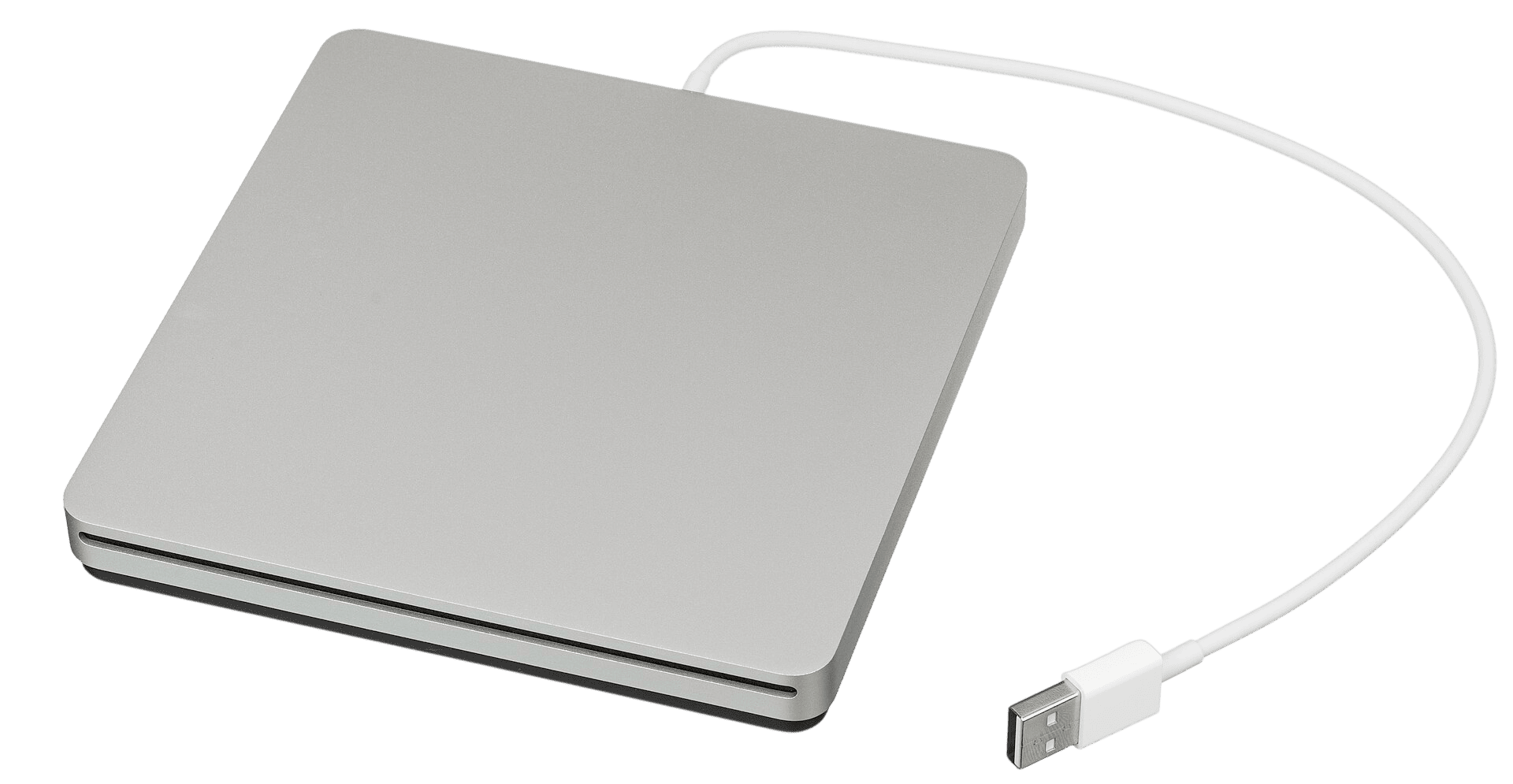 | Release Date 2012.06 Discontinued 2024.08 Color | 650-700 MBCD/CD-R/CD-RW 4.7 GBDVD/DVD±R/DVD±RW 8.5 GBDVD±R DL | USB 2.0 | Height: 17mm Width: 139mm Thickness: 139mm Weight: 335 g | A1379 | MD564LL/A | Apple introduced the MacBook Air SuperDrive alongside the first generation MacBook Air in January 2008. It was replaced by the USB SuperDrive in June 2012. Both feature identical specifications though the cable on the USB SuperDrive is slightly longer (340mm) compared to the MacBook Air SuperDrive (250mm). | ||
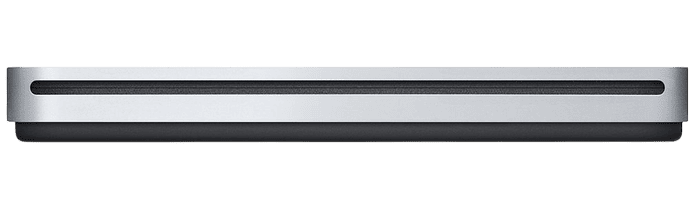 MacBook Air SuperDrive | Release Date 2008.01 Discontinued 2012.06 Color | 650-700 MBCD/CD-R/CD-RW 4.7 GBDVD/DVD±R/DVD±RW 8.5 GBDVD±R DL | USB 2.0 | Height: 17mm Width: 139mm Thickness: 139mm Weight: 320 g | A1270 | MB397G/A, MC684ZM/A | Apple introduced the MacBook Air SuperDrive alongside the first generation MacBook Air in January 2008. It was replaced by the USB SuperDrive in June 2012. Both feature identical specifications though the cable on the USB SuperDrive is slightly longer (340mm) compared to the MacBook Air SuperDrive (250mm). | ||
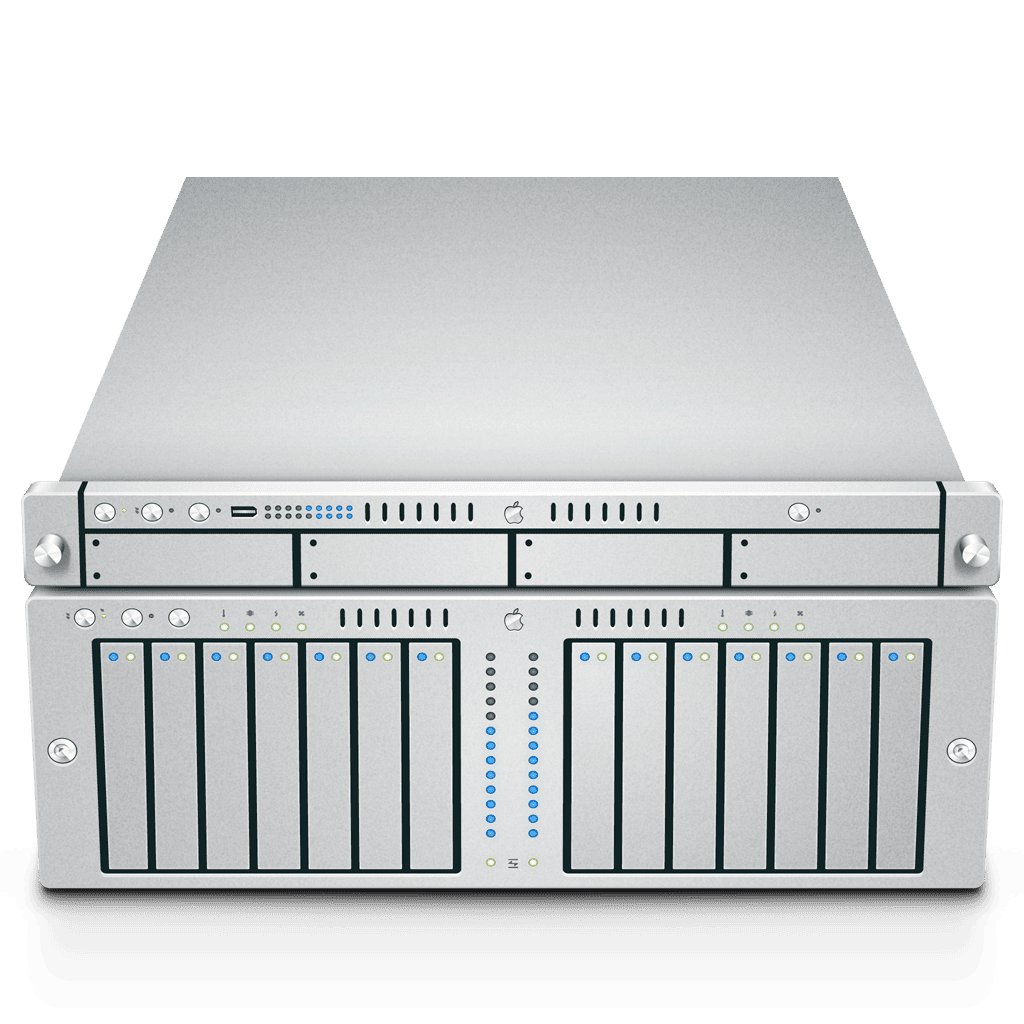 Xserve RAID (SFP Late 2004) | Release Date 2004.10 Discontinued 2008.02 Color | Up to 10.4 TB total capacity in RAID 0 | Fibre Channel | Height: 133mm Width: 432mm Thickness: 467mm Weight: 27.2 - 45.4 kg | A1009 | M9721LL/A (1 TB of storage), M9722LL/A (2.8 TB of storage), M9723LL/A (5.6 TB of storage) | Xserve RAID holds up to 14 hot-swappable Ultra-ATA hard drives with a maximum capacity of 10.5 TB when filled with 750 GB modules. Xserve RAID can be configured for most RAID levels. It is rack-mountable and is 3U high. Xserve RAID manages its hard drives with two identical RAID controller chipsets. The controllers are independent, but not redundant; each manages seven of the storage array's fourteen drives, given a failure of one of the controllers the other cannot take over its duties. Xserve RAID does, however, have redundant cooling units and power supplies. Xserve RAID's ports are two Fibre Channel ports for regular data transfer, a 10/100 Ethernet port for remote management, and a serial port for UPS communication via the Simple Signalling Protocol. Apple marketed Xserve RAID mainly as a companion to Xserve in file server and high-performance technical computing applications, but the storage array is also useful in some professional environments such as non-linear video editing. Xserve RAID was available in models costing between $5,999 U.S. and $12,999 U.S., plus configuration and support options. The Xserve RAID was discontinued on February 19, 2008. | ||
Xserve RAID (SFP) | Release Date 2004.01 Discontinued 2004.10 Color | Up to 3.5 TB total capacity in RAID 0 | Fibre Channel | Height: 133mm Width: 432mm Thickness: 467mm Weight: 27.2 - 45.4 kg | A1009 | M9271LL/A (1 TB storage), M9272LL/A (1.75 TB storage), M9293LL/A (3.5 TB storage) | The Xserve RAID had support for up to 14 180 GB drive modules, each on a separate ATA-100 bus. It used a dual 2GB Fibre Channel interface (a Fibre PCI card was available for Xserves), and had a maximum storage capacity of 2.52 TB. Prices ranged from $5,999 - $10,999 U.S. The Xserve RAID received an upgrade in January 2004: it now had support for up to 14 250 GB drive modules, each on a separate ATA-100 bus, for a total of 3.5 TB of possible storage. Prices ranged from $5,999 to $10,999 U.S. Another upgrade in October 2004 added 400 GB drive support bringing total capacity to 5.6 TB. Prices ranged from $5,999 to 12,999 U.S. | ||
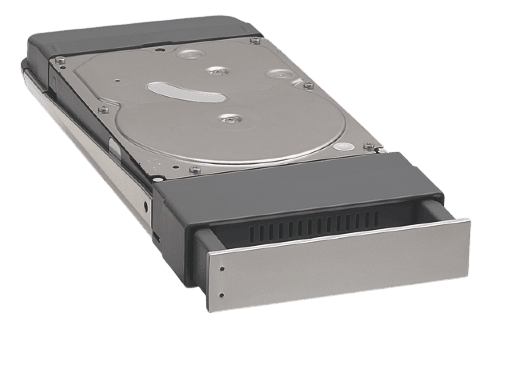 Apple Drive Module (SATA/SAS) | Release Date 2004.01 Discontinued 2011.01 Color | 74 GB 10,000-rpm, 80, 250, 400, 500, 750 GB, 1 or 2 TB 7,200-rpmSATA 73, 300, 450 GB 15,000-rpmSAS | Single Connector Attachment (SCA II) | 620-3647 (SATA) 620-4575 (SAS) | MA043G/A (74 GB) M9449G/A, MA506G/A (80 GB SATA) MB837G/A (160 GB SATA) M9450G/A (250 GB SATA) M9658G/A (400 GB SATA) MA207G/A (500 GB SATA) MA504G/A (750 GB SATA) MB838G/A (1 TB SATA) MC435G/A (2 TB SATA) MB098G/A, MA505G/A (73 GB SAS) MB097G/A, MA502G/A (300 GB SAS) TV823ZM/A (450 GB SAS) | Apple Drive Modules were hot-swappable hard drives for Xserve and Xserve RAID. The modules had LEDs indicating drive health and activity. Each drive module was connected to an independent bus on both Xserve and Xserve RAID. A locking mechanism held the modules in place. They were available in ATA, SATA, and SAS configurations. | |||
Xserve RAID | Release Date 2003.02 Discontinued 2004.01 Color | Up to 2.52 TB total capacity in RAID 0 | Fibre Channel | Height: 133mm Width: 432mm Thickness: 467mm Weight: 27.2 - 45.4 kg | A1009 | M8668LL/A (720 GB storage), M8669LL/A (1.26 TB storage), M8670LL/A (2.52 TB storage) | The Xserve RAID had support for up to 14 180 GB drive modules, each on a separate ATA-100 bus. It used a dual 2GB Fibre Channel interface (a Fibre PCI card was available for Xserves), and had a maximum storage capacity of 2.52 TB. Prices ranged from $5,999 - $10,999 U.S. The Xserve RAID received an upgrade in January 2004: it now had support for up to 14 250 GB drive modules, each on a separate ATA-100 bus, for a total of 3.5 TB of possible storage. Prices ranged from $5,999 to $10,999 U.S. Another upgrade in October 2004 added 400 GB drive support bringing total capacity to 5.6 TB. Prices ranged from $5,999 to 12,999 U.S. | ||
Apple Drive Module (ATA) | Release Date 2002.07 Discontinued 2008.02 Color | 60, 120, 180, 250, 400, 500, 750 GB 7,200-rpm | Single Connector Attachment (SCA II) | 620-3084-C | M8791G/A (60 GB) M8792G/A (120 GB) M8939G/A (180 GB) M9356G/A (250 GB) M9741G/A (400 GB) MA180G/A (500 GB) MA852G/A (750 GB) | Apple Drive Modules were hot-swappable hard drives for Xserve and Xserve RAID. The modules had LEDs indicating drive health and activity. Each drive module was connected to an independent bus on both Xserve and Xserve RAID. A locking mechanism held the modules in place. They were available in ATA, SATA, and SAS configurations. | |||
Macintosh PowerBook 2400c Floppy Disk Drive | Release Date 1997.05 Discontinued 1998.12 Color | 2.0 MBunformatted 1.416 MBformatted | Macintosh PowerBook 2400c Floppy Disk Drive | M4327 | M5853LL/A | Compatible only with the PowerBook 2400c, the Macintosh PowerBook 2400c Floppy Disk Drive (M4327) used a unique Molex connector rather than the previous HDI-20 connector. Possibly because of the 2400c's IBM design heritage, both the drive and the computer use the same connectors as IBM ThinkPad external floppy drives from the same period; however, IBM drives are not electrically compatible. The drive was discontinued in 1998 and would be the last external floppy drive manufactured by Apple. | |||
AppleCD 600e | Release Date 1995.05 Discontinued 1997 Color | 656 MBMode 1 748 MBMode 2 | SCSI | Height: 59mm Width: 158mm Thickness: 323mm Weight: 2.60 kg | M3958 | M3958LL/A | AppleCD is a range of SCSI-based CD-ROM drives manufactured and sold from the late 1980s to late 1990s. Earlier AppleCD drives required a CD caddy in order to be used, while later models used a tray-loading mechanism. The original model introduced in 1988 was simply called the AppleCD SC. Several other models were made, including the AppleCD SC Plus, 150, 300, 300 Plus, 300e Plus, 300i Plus, 600e, 600i, and 1200i ('e' representing an external drive, and 'i' representing internal; model number also represents data reading speed in KB/s) | ||
AppleCD 300e Plus | Release Date 1994.06 Discontinued 1995.05 Color | 656 MBMode 1 748 MBMode 2 | SCSI | Height: 59mm Width: 158mm Thickness: 323mm Weight: 2.60 kg | M2918 | M2918LL/A | AppleCD is a range of SCSI-based CD-ROM drives manufactured and sold from the late 1980s to late 1990s. Earlier AppleCD drives required a CD caddy in order to be used, while later models used a tray-loading mechanism. The original model introduced in 1988 was simply called the AppleCD SC. Several other models were made, including the AppleCD SC Plus, 150, 300, 300 Plus, 300e Plus, 300i Plus, 600e, 600i, and 1200i ('e' representing an external drive, and 'i' representing internal; model number also represents data reading speed in KB/s) | ||
Apple External Hard Drive | Release Date 1993.09 Discontinued 1997 Color | 160, 230, 270, 340, 500, 540, 850 MB 1.0, 2.1, 3.2, 4.0, 6.0, 6.4, 9.1 GB | SCSI | Height: 163mm Width: 66mm Thickness: 269mm Weight: 1.7 - 2.0 kg | M2115 | M1861LL/A (160 MB) M1862LL/A (230 MB) M1863LL/A (500 MB) M1864LL/A (1.0 GB) | The Apple External Hard Drive provides Macintosh computer owners with a convenient, easy storage upgrade option that comes in capacities of up to 9 gigabytes. Featuring a flexible, aesthetic design, the Apple External Hard Drive can be set up either vertically or horizontally. And its front panel controls make it convenient to use no matter how it's positioned. The drive comes with a variety of utility software, including powerful disk-repair utilities, file-compression software, and a comprehensive backup utility, so operation is a snap. | ||
Apple PowerCD | Release Date 1993.06 Discontinued 1995 Color | 656 MBMode 1 748 MBMode 2 | SCSI | Height: 165mm Width: 220mm Thickness: 125mm Weight: 1.4 kg | H0020 | H0014LL/B (Consumer) H0013LL/A (Business) | Apple PowerCD was announced on March 22, 1993 and released at the end of June 1993. It was a re-badged Philips-designed product (Philips CDF-100) which was sold in addition to Apple's speakers and also included a remote control. The PowerCD was capable of reading Kodak photo CDs, data CDs and audio CDs. It can connect to Macintosh personal computers through SCSI and also to stereo systems and televisions. With the success of the Apple Newton, in mid-1992 Apple Industrial Design Group created a division called Mac Like Things which was to focus on what they saw as a whole new market for Apple in consumer electronic devices. The PowerCD marked Apple's first stand-alone consumer-oriented product brought to market, which did not require a computer for use. It was analogous to Sony's Discman portable CD players of the time, however, unlike Sony's and most others, Apple's could also be used as computer peripheral as well. And while most desktop Macs at the time included built-in CD-ROMs, the PowerCD was designed to match the PowerBook series which would not include a built-in CD-ROM for several more years. Its ability to be operated under battery power alone made it not only a portable drive for computers, but gave it the added ability to be marketed as a stand-alone portable CD player. | ||
AppleCD 300 | Release Date 1992.10 Discontinued 1994.06 Color | 656 MBMode 1 748 MBMode 2 | SCSI | Height: 50mm Width: 178mm Thickness: 334mm Weight: 2.85 kg | M3023 | M2710LL/A | AppleCD is a range of SCSI-based CD-ROM drives manufactured and sold from the late 1980s to late 1990s. Earlier AppleCD drives required a CD caddy in order to be used, while later models used a tray-loading mechanism. The original model introduced in 1988 was simply called the AppleCD SC. Several other models were made, including the AppleCD SC Plus, 150, 300, 300 Plus, 300e Plus, 300i Plus, 600e, 600i, and 1200i ('e' representing an external drive, and 'i' representing internal; model number also represents data reading speed in KB/s) | ||
AppleCD 150 | Release Date 1992.03 Discontinued 1994.06 Color | 656 MBMode 1 748 MBMode 2 | SCSI | Height: 49mm Width: 178mm Thickness: 325mm Weight: 2.9 kg | M3022 | M2700LL/D | AppleCD is a range of SCSI-based CD-ROM drives manufactured and sold from the late 1980s to late 1990s. Earlier AppleCD drives required a CD caddy in order to be used, while later models used a tray-loading mechanism. The original model introduced in 1988 was simply called the AppleCD SC. Several other models were made, including the AppleCD SC Plus, 150, 300, 300 Plus, 300e Plus, 300i Plus, 600e, 600i, and 1200i ('e' representing an external drive, and 'i' representing internal; model number also represents data reading speed in KB/s) | ||
Macintosh HDI-20 External 1.4MB Floppy Disk Drive | Release Date 1991.10 Discontinued 1997.02 Color | 2.0 MBunformatted 1.416 MBformatted | HDI-20 | Height: 28mm Width: 114mm Thickness: 178mm Weight: 0.65 kg | M8061 | M8061LL/A | Manufactured exclusively for use with the Macintosh PowerBook line, the Macintosh HDI-20 External 1.44MB Floppy Disk Drive (M8061) contained a low-powered, slimmer version of the SuperDrive and used a small square HDI-20 proprietary connector, rather than the larger standard DE-19 desktop connector, and was powered directly by the laptop. It had a matching dark gray case and an access cover which flipped down to form a stand. The external drive was sold optionally for those PowerBooks which had no built-in drive, however, the identical drive mechanism was included internally in some PowerBook models, which otherwise had no provision to accommodate an external drive. | ||
AppleCD SC Plus | Release Date 1991.06 Discontinued 1992.03 Color | 656 MBMode 1 748 MBMode 2 | SCSI | Height: 84mm Width: 246mm Thickness: 266mm Weight: 4 kg | M3021 | M2700LL/C | The AppleCD SC Plus was Apple's second CD-ROM drive, a replacement for the AppleCD SC which was introduced in 1991. Identified as model number M3021, just like its predecessor, the AppleCD SC, it used a 1x Read Only Media CD-ROM drive. The Plus could read a CD with up to 750 MB of data over the 650 MB of the AppleCD SC. It had indicator lights, an eject button, mini-phone audio jack, volume knob, and the CD caddy drive on the front of the accessory. On the back there were two 50-pin Centronics SCSI connectors, audio RCA connectors, power input, and a power switch. The AppleCD SC Plus had only minor improvements over the AppleCD SC and it was relatively the same. | ||
Apple FDHD / SuperDrive | Release Date 1989.04 Discontinued 1994.06 Color | 2.0 MBunformatted 1.416 MBformatted | DB-19 | Height: 51mm Width: 120mm Thickness: 200mm Weight: 1.3 kg | G7287 | M0112, M0112LL/B | Later renamed the Apple SuperDrive (G7287), the Apple FDHD Drive (Floppy Disk High Density) was introduced in 1989 as Apple's first external 1.44 MB high-density double-sided 3.5-inch floppy drive. It supported all of Apple's 3.5-inch floppy disk formats as well as all standard PC formats (e.g. MS-DOS, Windows), allowing the Macintosh to read and write all industry standard floppy disk formats. The external drive was offered only briefly with support for the Apple II, coming late in that product's life. To take advantage of the drive's extended storage and new capabilities, it required the new SWIM (Sander–Wozniak Integrated Machine) floppy disk controller chip to be present on the Macintosh and Apple II, the latter requiring the Apple II 3.5 Disk Controller Card which integrated the chip. If the drive was connected to an older Macintosh, Apple IIGS or Apple IIc Plus with the older IWM (Integrated Woz Machine) chip, the drive would act as a standard 800K drive, without any additional capabilities. The interface card was necessary for the Apple IIGS to make use of its greater storage capacity and ability to handle PC formats. The Apple IIe could not utilize the drive in any form, unless it had the specialized interface card installed, much like the UniDisk 3.5 which the SuperDrive replaced. The last Mac it could be used with was the Classic II and was discontinued shortly thereafter. The drive was fitted in every desktop Mac from its introduction and was eliminated with the introduction of the iMac in 1998. PowerPC Macs dropped the original auto-inject Sony drives and went to a manual inject mechanism. | ||
Apple Hard Disk 160SC | Release Date 1989.03 Discontinued 1989 Color | 160 MB3,600-rpm | SCSI | Height: 79mm Width: 250mm Thickness: 270mm Weight: 4.3 kg | M2666 | The Apple Hard Disk 20SC was Apple's first SCSI based hard drive for the Apple II family as well as the Macintosh. The case design would be reused unchanged (in Platinum only) for 2 more models introduced the following year: 40SC and 80SC and 160SC in 1989. In addition to being the first cross-platform drive offered by Apple it was the first hard drive to use the Snow White design language. Notably, it was the only Snow White product to use the Macintosh beige color and one of the few Apple products to be introduced in two different colors at the same time. Since the Apple IIGS was the first Apple product to debut in the new gray color they called Platinum, the 20SC had to both match it and the beige color of the Macintosh Plus, which it is designed to sit perfectly beneath. In 1987, all Apple products would change to Platinum, which would remain in use for the next 10 years. | |||
AppleCD SC | Release Date 1988.03 Discontinued 1991.06 Color | 656 MBMode 1 748 MBMode 2 | SCSI | Height: 84mm Width: 246mm Thickness: 266mm Weight: 4 kg | M2850 | M2700LL/A | The AppleCD SC was the first CD-ROM by Apple, introduced in 1988. It originally contained a fan but in 1990 they removed it because it was unneeded and attracted dust onto the optical disk head which could cause problems. It uses a front-loading caddy 1x CD-ROM and is only capable of Read Only Media. This accessory device was only able to read compact discs up to a 650 MB capacity in five formats, CD-Audio, CD-ROM, HFS, ProDOS, and High Sierra. On the front of the device it has an eject button, mini-phono sound out jack, and a volume knob. On the rear it has a power switch, power input, two Centronics 50-pin SCSI outputs, and an audio RCA connector. With appropriate software it would run on any Macintosh with a DB-25 connector, or an Apple II with an Apple II SCSI interface card. | ||
Apple Hard Disk 20SC | Release Date 1986.09 Discontinued 1989 Color | 20 MB2,744 or 3,600-rpm | SCSI | Height: 79mm Width: 250mm Thickness: 270mm Weight: 3.35 kg | M2603 (Putty) / M2604 (Platinum) | M2620/A | The Apple Hard Disk 20SC was Apple's first SCSI based hard drive for the Apple II family as well as the Macintosh. The case design would be reused unchanged (in Platinum only) for 2 more models introduced the following year: 40SC and 80SC and 160SC in 1989. In addition to being the first cross-platform drive offered by Apple it was the first hard drive to use the Snow White design language. Notably, it was the only Snow White product to use the Macintosh beige color and one of the few Apple products to be introduced in two different colors at the same time. Since the Apple IIGS was the first Apple product to debut in the new gray color they called Platinum, the 20SC had to both match it and the beige color of the Macintosh Plus, which it is designed to sit perfectly beneath. In 1987, all Apple products would change to Platinum, which would remain in use for the next 10 years. | ||
Apple Hard Disk 40SC | Release Date 1986.09 Discontinued 1989 Color | 40 MB3,660 or 3,662-rpm | SCSI | Height: 79mm Width: 250mm Thickness: 270mm Weight: 3.4 kg | M2644/A | The Apple Hard Disk 20SC was Apple's first SCSI based hard drive for the Apple II family as well as the Macintosh. The case design would be reused unchanged (in Platinum only) for 2 more models introduced the following year: 40SC and 80SC and 160SC in 1989. In addition to being the first cross-platform drive offered by Apple it was the first hard drive to use the Snow White design language. Notably, it was the only Snow White product to use the Macintosh beige color and one of the few Apple products to be introduced in two different colors at the same time. Since the Apple IIGS was the first Apple product to debut in the new gray color they called Platinum, the 20SC had to both match it and the beige color of the Macintosh Plus, which it is designed to sit perfectly beneath. In 1987, all Apple products would change to Platinum, which would remain in use for the next 10 years. | |||
Apple Hard Disk 80SC | Release Date 1986.09 Discontinued 1989 Color | 80 MB3,662-rpm | SCSI | Height: 79mm Width: 250mm Thickness: 270mm Weight: 3.45 kg | M2688/A | The Apple Hard Disk 20SC was Apple's first SCSI based hard drive for the Apple II family as well as the Macintosh. The case design would be reused unchanged (in Platinum only) for 2 more models introduced the following year: 40SC and 80SC and 160SC in 1989. In addition to being the first cross-platform drive offered by Apple it was the first hard drive to use the Snow White design language. Notably, it was the only Snow White product to use the Macintosh beige color and one of the few Apple products to be introduced in two different colors at the same time. Since the Apple IIGS was the first Apple product to debut in the new gray color they called Platinum, the 20SC had to both match it and the beige color of the Macintosh Plus, which it is designed to sit perfectly beneath. In 1987, all Apple products would change to Platinum, which would remain in use for the next 10 years. | |||
Apple 3.5 Drive | Release Date 1986.09 Color | 1,246 KBunformatted 800 KBformatted | DB-19 | Height: 51mm Width: 120mm Thickness: 200mm Weight: 1.3 kg | A9M0106 | - | Beginning in September 1986, Apple adopted a unified cross-platform product strategy essentially eliminating platform-specific peripherals where possible. The Apple 3.5 Drive (A9M0106) is an 800K external drive released in conjunction with the Apple IIGS computer and replaced the beige-colored Macintosh 800K External Drive. It works on both the Apple IIGS as well as the Macintosh. It came in a case similar to the UniDisk, but in Platinum gray. Like the UniDisk 3.5, the Apple 3.5 Drive includes Apple II-specific features such as a manual disk eject button and a daisy-chain connector which allows two drives to be connected to an Apple II computer. The Macintosh however could still only accommodate one external drive, and ignores use of the eject button. Unlike the Macintosh 800K External Drive, the Apple 3.5 Drive can be used natively with the 64-kilobyte ROM stock Macintosh 128K and 512K computers without the HD20 INIT, albeit only with 400K MFS formatted disks. Designed as a universal external drive replacement, the Apple 3.5 Drive was eventually made compatible with the remaining Apple II models in production upon the introduction of the Apple IIc Plus and the Apple II 3.5 Disk Controller Card for the Apple IIe. | ||
Macintosh 800K External Drive | Release Date 1986.01 Discontinued 1986.09 Color | 1,246 KBunformatted 800 KBformatted | DB-19 | Height: 49mm Width: 120mm Thickness: 200mm Weight: 1.29 kg | M0131 | - | In January 1986, Apple introduced the Macintosh Plus which had a Sony double-sided 800-kilobyte capacity disk drive, and used the new HFS disk format providing directories and sub-directories. This drive was fitted into an external case as the Macintosh 800K External Drive (M0131), which was slimmer than the earlier 400-kilobyte drive. It could be used with Macintosh models except for the original 128K, which could not load the HFS disk format. The drive supported the older 400-kilobyte single-sided disks allowing them to be shared. The use of Apple's GCR with variable speed (as used on the 400-kilobyte drive) accommodated a higher storage capacity than its 720-kilobyte PC counterparts. In addition, the mechanism was much quieter and significantly faster than its predecessor. Designed primarily to run on Macs with the new 128-kilobyte ROM which contained the necessary code to support the drive, it could be used with Macs with older 64-kilobyte ROMs if the proper software was loaded from the system folder of a Hard Disk 20 into the Mac's RAM. The drive controlled its own speed and was no longer dependent on an external signal from the Mac, which was blocked on the early drive mechanisms compatible only with the Macintosh. Later universal mechanisms, first used on the Apple II to accommodate proprietary signals, required special cables to isolate the speed signal from the Mac, to prevent damage to the drive. However, with its increased storage capacity combined with 2-4 times the RAM available on the Mac Plus, the external drive was less of a necessity than it had been with its predecessors. Nevertheless, with the only option for adding additional storage being extremely expensive hard drives, a year later Apple increased the maximum number of floppy drives that could be accessed simultaneously to three on the Macintosh SE (the Macintosh Portable was the only other Mac to do so). | ||
Macintosh Hard Disk 20 | Release Date 1985.09 Discontinued 1987.09 Color | 20 MB at 2,744-rpm | DB-19 | Height: 79mm Width: 250mm Thickness: 270mm Weight: 3.2 kg | M0135 | - | The Macintosh Hard Disk 20 was the first hard drive developed by Apple specifically for use with the Macintosh 512K. Introduced on September 17, 1985, it was part of Apple's long awaited solution toward completing the Macintosh Office (a suite of integrated business hardware and software) announced in January 1985. At the time when the average file size was around 10-20 kB and due to the vast number of those files the HD 20 could contain, Apple's original Macintosh File System, which did not allow for directories, would have made organizing those files unwieldy. Therefore, Apple introduced it with a new System and Finder update which included the brand new Hierarchical File System allowing the user to better organize files on such a large volume. As a result, only the Macintosh 512K could access it; the original Macintosh 128K did not have enough RAM to load the new file system. Most of the hard drives which were available on the market used the slower serial port to transfer data per Apple's specifications. Apple instead engineered the HD 20 to use the faster floppy disk port, enabling the user to daisy-chain an external floppy disk drive as well as an additional HD 20. | ||
Apple DuoDisk | Release Date 1984.05 Color | 113.75 KBApple DOS 3.2.1 140 KBApple DOS 3.3 and ProDOS | DB-25 or DB-19 | Height: 365mm Width: 200mm Thickness: 70mm Weight: 3.8 kg | A9M0108 | - | In 1984, shortly after the introduction of the Apple IIe the previous year, Apple offered a combination of two, two third-height, 140-kilobyte Disk II drive mechanisms side-by-side in a single plastic case, called the DuoDisk (A9M0108), which could not be daisy-chained. The unit was designed to be stacked on top of the computer, and beneath the monitor. Each unit required its own disk controller card (as each card could still control only two drives) and the number of units was thus limited to the number of available slots; in practice, few uses of the Apple II computer can make good use of more than two 5+1⁄4-inch drives, so this limitation mattered little. Originally released with a DB-25 connector to match that of the Apple III Plus, it was the first to adopt Apple's standard DB-19 floppy drive connector. | ||
Macintosh 400K External Drive | Release Date 1984.05 Discontinued 1986.01 Color | 437.5 KBunformatted 409.6 KBformatted | DB-19 | Height: 51mm Width: 102mm Thickness: 130mm Weight: 0.68 kg | M0130 | - | The original Macintosh External Disk Drive (M0130) was introduced with the Macintosh on January 24, 1984. However, it did not actually ship until May 4, 1984. The drive case was designed to match the Macintosh and included the same 400-kilobyte drive (a Sony-made 3+1⁄2-inch single-sided mechanism) installed inside the Macintosh. The Macintosh could only support one external drive, limiting the number of floppy disks mounted at once to two, but both Apple and third party manufacturers developed external hard drives that connected to the Mac's floppy disk port, which had pass-through ports to accommodate daisy-chaining the external disk drive. Apple's Hard Disk 20 could accommodate an additional daisy-chained hard drive as well as an external floppy disk. The external 400-kilobyte Macintosh drive will work on any Macintosh that does not have a high density SuperDrive controller (due to electrical changes with the interface), but the disks in practice only support the MFS file system. Although a 400-kilobyte disk may be formatted with HFS, it cannot be booted from, nor is it readable in a Mac 128 or 512. | ||
Apple Disk IIc | Release Date 1984.04 Color | 140 KB | DB-19 | Height: 65mm Width: 165mm Thickness: 215mm | A2M4050 | A2M4050 | The Disk IIc (A2M4050) was a half-height 5+1⁄4-inch floppy disk drive introduced by Apple Computer in 1984 styled for use alongside the Apple IIc personal computer, the only Apple II to contain a 5+1⁄4-inch built-in disk drive mechanism. The disk port on the original IIc was only designed to control one additional, external 5+1⁄4-inch disk drive, and as such, this particular drive omitted a daisy-chain port in back. It was possible to use it on other Apple II models, so long as it came last in the chain of drive devices (due to lacking a daisy-chain port); but since the Disk IIc was sold without a controller card, the Apple IIc computer needing none, it had to be adapted to an existing Disk II controller card in this case. Essentially the same as the full-height Disk II, Apple sold the Disk IIc for US$329. | ||
Apple ProFile | Release Date 1981.09 Discontinued 1986.09 Color | 5 or 10 MB at 3,600-rpm | DB-25 | Height: 112mm Width: 439mm Thickness: 224mm Weight: 5 kg | A9M0005 (5 MB) A9M0100 (10 MB) | The ProFile was Apple's first hard drive. It was introduced in September 1981 at a price of $3,499 U.S., initially for use with the Apple III. The original model had a formatted capacity of 5 MB and connected to a special interface card that plugged into an Apple III slot. In 1983 Apple offered a ProFile interface card for the Apple II, with software support for Apple ProDOS and Apple Pascal. Also in 1983, Apple introduced the Lisa computer, which was normally sold with a ProFile. The ProFile could be connected to the built-in parallel port of the Lisa, or to a port of an optional dual-port parallel interface card. Up to three such interface cards could be installed, so in principle up to seven ProFile drives could be used on a Lisa. Later a 10 MB model was offered, but required an upgraded PROM/interface card to recognize the additional 5 MB. | |||
Apple Disk III | Release Date 1980.11 Discontinued 1985.09 Color | 140 KB | 26-pin ribbon cable or DB-25 (with adapter) | Height: 104mm Width: 161mm Thickness: 224mm Weight: 1.36 kg | A3M0004 | A3M0004 (no adapter) A3P0016 (with adapter) | The first variation of the Disk II introduced for the Apple III, called the Disk III (A3M0004), used the identical drive mechanism inside a modified plastic case with a proprietary connector. With some modification both drives are interchangeable. Though Apple sought to force the purchase of new drives with the Apple III, many former Apple II users quickly devised a way to adapt their existing and cheaper Disk II drives; however, only one external Disk II was supported in this manner. The Disk III was the first to allow daisy chaining of up to three additional drives to the single 26-pin ribbon cable connector on the Apple III, for a total of 4 floppy disk drives – the Apple III was the first Apple to contain a built-in drive mechanism. The Apple III Plus changed its 26-pin connector to a DB-25 connector, which required an adapter for use with the Disk III. | ||
Disk II | Release Date 1978.07 Discontinued 1984.05 Color | 113.75 KBApple DOS 3.2.1 140 KBApple DOS 3.3 and ProDOS | 20-pin ribbon cable or DB-19 (with adapter) | Height: 83mm Width: 146mm Thickness: 203mm Weight: 1.36 kg | A2M0003 | A2M0003 (without controller) A2M0004, A2M0044 (with controller) | The Disk II Floppy Disk Subsystem is a 5.25-inch floppy disk drive designed by Steve Wozniak at the recommendation of Mike Markkula. Apple did not originally offer a disk drive for the Apple II, which used data cassette storage like other microcomputers of the time. It was announced in June 1978 at a retail price of $495 U.S. for pre-order; it was later sold for $595 U.S. including the controller card (which can control up to two drives) and cable. The initial Disk II drives (A2M0003) were modifications of the Shugart SA-400, which was the first commercially available 5.25-inch diskette drive. Apple purchased only the bare drive mechanisms without the standard SA-400 controller board, replaced it with Wozniak's disk interface board design, and then stamped the Apple logo onto the faceplate. Wozniak called the resultant Disk II system "my most incredible experience at Apple and the finest job I did", and credited it and VisiCalc with the Apple II's success. Early production at Apple was handled by two people, and they assembled 30 drives a day. By 1982, Apple switched to Alps drives for cost reasons. The drive connected to the controller card via a 20-pin ribbon cable; the controller card was plugged into one of the bus slots on the Apple II's logicboard. DB-19 adapters were eventually available for use with Apple's later connector standard. Up to 14 drives could be attached to one Apple II or Apple IIe computer - two drives per controller card, one card per slot, and there were seven usable slots per computer. Apple's printed manuals suggested using slot 6 for the first controller card. |